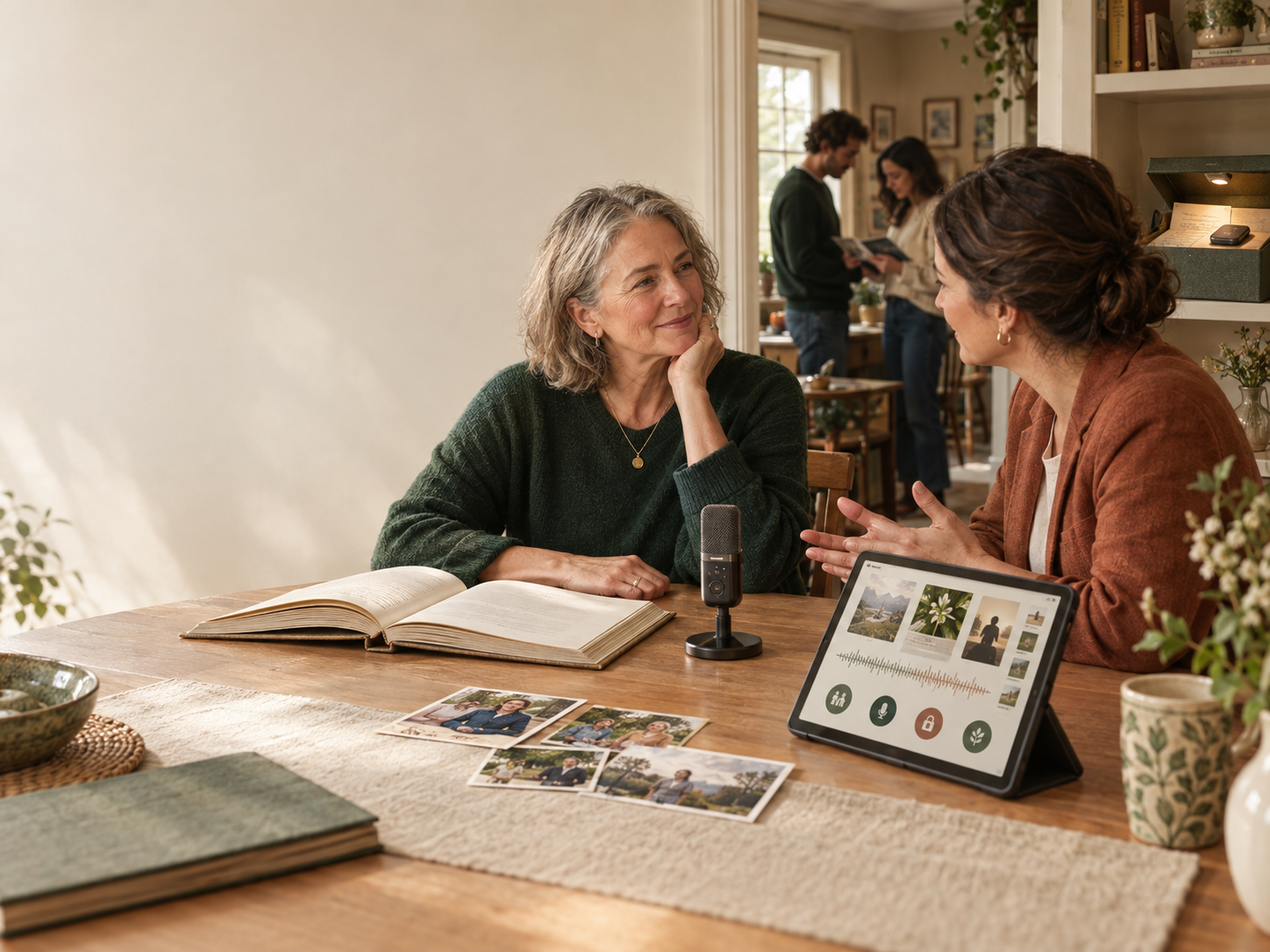
Person-led with care
Our approach is person-led and consent-first: we support people of any age—including those living with a life-limiting or terminal illness, as well as older or potentially vulnerable individuals—to share their stories at their own pace, with clear control over what is included, who may contribute and who may receive it.
Our approach
We believe every person should have the opportunity to tell their story in their own words—at any stage of life, and in a way that feels safe, unhurried and meaningful.
Our approach is person-led and consent-first. We support people of all ages, including those living with a life-limiting or terminal illness, as well as older people and others who may be vulnerable, to capture the memories, values, experiences and messages they wish to pass on. We do not see a life story as something to be collected by others; it belongs first to the person whose life it is.
That means the storyteller remains at the centre of every decision. They choose what to include, what to leave private, whether to invite family or friends to contribute, and who may receive the finished book, recording or digital Life Capsule. They can take part at their own pace, pause where needed and change their mind as their circumstances or wishes evolve.
Dignity, choice and control
Life stories can contain deeply personal material: family relationships, health experiences, beliefs, losses, achievements, regrets and hopes for those who come after. Some memories may be joyful; others may be difficult, incomplete or not for sharing.
We create space for people to tell only the story they want to tell. There is no expectation to answer every question, resolve every relationship or create a polished version of a life. The purpose is not to judge, verify or sanitise someone’s memories. It is to help them preserve what matters to them, in a format that reflects their voice and choices.
Where family contributions are invited, they are an addition to—not a replacement for—the storyteller’s perspective. Contributions are shared only within the boundaries agreed by the person at the centre of the story.
Supporting vulnerable customers
Some people may come to this service during periods of illness, grief, major transition, reduced confidence or increased reliance on family members. We recognise that these circumstances can make consent, privacy and decision-making especially important.
Our role is to support, not pressure. We use clear, accessible language and allow time for reflection. We encourage people to involve a trusted person where that is helpful, while ensuring that the storyteller’s own wishes remain central.
We are attentive to situations in which someone may feel rushed, influenced or unable to make a free choice. Where there are concerns about understanding, undue pressure or conflicting family expectations, we will pause and take an appropriately cautious approach. A meaningful legacy cannot be built on assumptions about what someone would have wanted.
Family participation
Family and friends often hold precious shared memories, photographs and perspectives. Inviting them to contribute can create a richer, more connected account of a life—particularly across generations.
However, family participation is always by invitation and subject to the storyteller’s choices. The person whose story is being recorded decides:
Whether others can contribute
Who may be invited
What type of contribution is appropriate, such as a photograph, written memory, audio message or shared reflection
Whether they wish to see or approve contributions before inclusion
What is included in the final physical books and digital Life Capsule
Who may receive access now or in the future
This creates a more respectful alternative to a family archive assembled without the knowledge or involvement of the person at its heart.
Privacy and lasting care
A life story may include information that is personal, sensitive or intended only for a small number of people. We therefore treat privacy as part of the experience—not as an afterthought.
Our digital products are designed around clear permissions, defined access and meaningful choices. We aim to make it understandable what is being collected, why it is being used, where it will appear and who will be able to access it. The person can decide whether their story becomes a printed book, a private digital collection, an audio recording, a shared family experience, or a combination of these.
A Life Capsule is not simply a repository of data. It is a carefully held collection of memories, messages, recordings and materials for the people the storyteller chooses. Its value lies not only in preserving information, but in respecting the context, relationships and permissions attached to it.
A living legacy
Our work is not only about looking back. It is about connection in the present and continuity for the future.
A curated book, recorded conversation or digital Life Capsule can help families share stories that might otherwise go unspoken: the values that shaped someone, the moments they are proud of, the lessons they hope others will carry forward, and the small details that make a person recognisable to those who love them.
Whether someone is reflecting on a life already richly lived, creating something for children and grandchildren, navigating serious illness, or simply wanting to preserve their story while they can, we approach every account with care, respect and humanity.
Your story. Your voice. Your choice.